

Commercial Decorating: Refreshing Office & Retail Spaces
Office and retail interiors can begin to look tired gradually. Scuffed walls, worn paintwork and dated colour schemes may not stop a business from operating, but they can influence how employees, customers and visitors perceive the environment. Periodic decorating can refresh a commercial property without necessarily requiring a complete refurbishment.
Businesses planning a larger refresh may choose experienced commercial decorating services to manage preparation and finishing across offices, shops and other business environments. The scope should be based on the condition and use of the premises rather than simply applying a new coat of paint to every visible surface.
A successful commercial decorating project also needs to account for normal business activity. Contractors may need to work around desks, displays, electrical fittings and customers, making planning and sequencing just as important as the final colour choice.
Assess the Existing Space First
Before choosing colours, inspect what is already there.
Walls may contain cracks, damaged plaster, stains, loose coatings or previous repairs that need attention. Timberwork and other painted surfaces may also require preparation before they can be redecorated successfully.
Look at the property as a whole rather than focusing only on the most visible areas.
Corridors, meeting rooms, staff areas and customer facilities can deteriorate at different rates. High-contact locations around doors and circulation routes may need more attention than quieter areas.
An initial assessment helps establish the actual scope.
It also provides an opportunity to identify repairs that should happen before decorating begins, preventing newly painted surfaces from being disturbed shortly afterwards.
Choose Finishes for Commercial Use
Appearance matters, but commercial decorating also needs to reflect how the space is used.
A quiet meeting room and a busy retail corridor may place very different demands on a painted surface.
Consider durability, cleaning requirements and the manufacturer's recommendations when selecting finishes.
Areas that regularly experience contact may benefit from products suited to greater wear, while other spaces may allow more emphasis on appearance.
Facilities managers should also think about how surfaces will be maintained after completion.
A finish that requires complicated care may not be ideal where routine cleaning is carried out by a large facilities team.
The appropriate choice balances the design brief with everyday practicality.
Use Colour With a Purpose
Colour can influence the character of a commercial interior, but decisions should support the space rather than follow trends automatically.
Retailers may want colours that complement their branding and product displays. Offices might use different tones to distinguish collaboration areas, meeting rooms or quieter working spaces.
Existing furniture, flooring and lighting should be considered before making a final selection.
A colour viewed on a small sample can appear different when applied across an entire wall or under artificial lighting.
Testing representative samples in the actual space can therefore be useful.
Consider how they look at different times of day and alongside the materials that will remain after decorating.
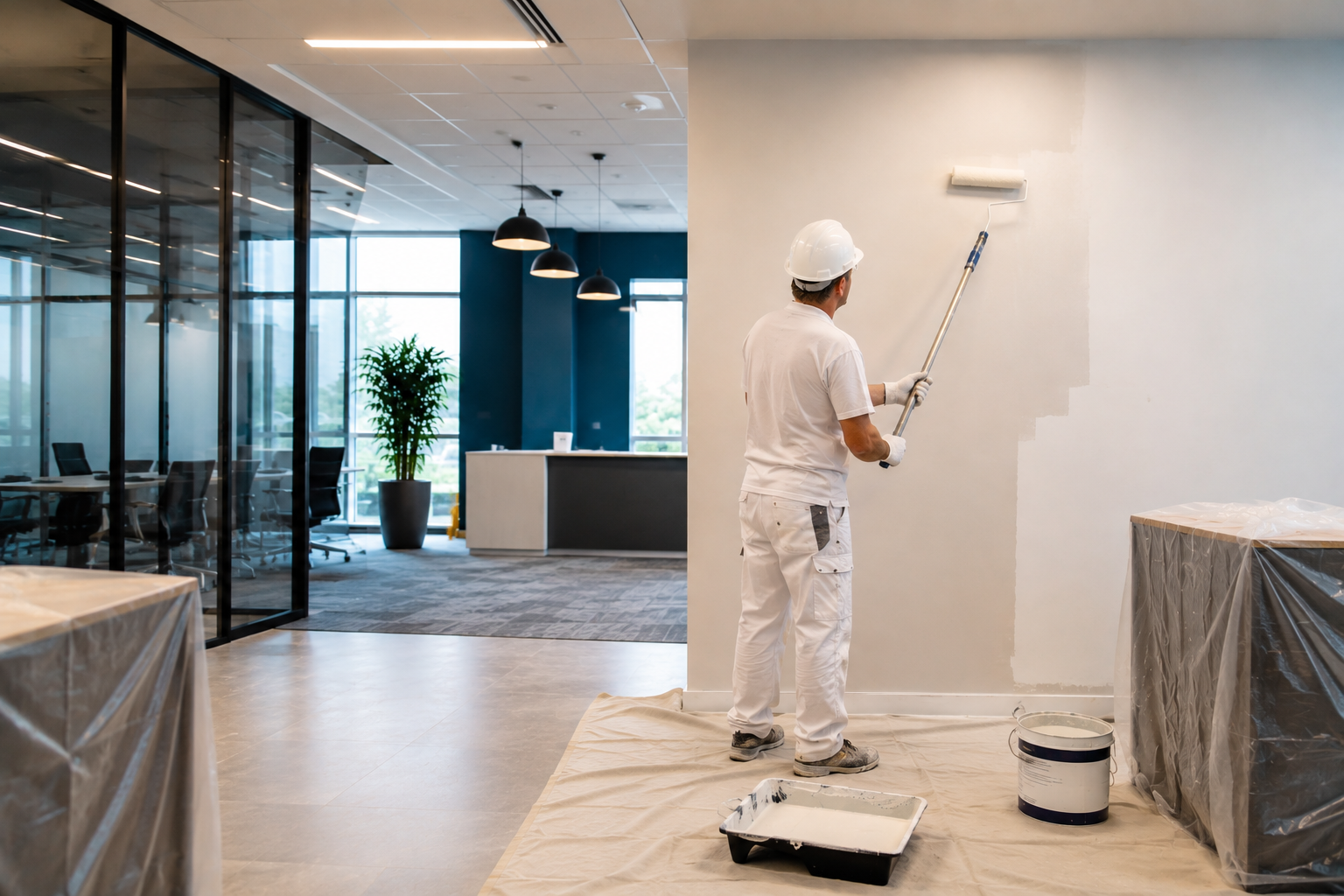
Give Surface Preparation Enough Attention
The quality of the finished surface depends heavily on preparation.
Loose or failing coatings may need removing, cracks and holes may require filling and surfaces should be prepared appropriately for the selected coating system.
Rushing this stage to reduce downtime can produce disappointing results.
Preparation may also generate dust and disruption, which needs to be considered in occupied commercial premises.
Work areas should be controlled appropriately, and nearby furniture or equipment may need protection.
Where existing surfaces show significant deterioration, investigate the cause rather than simply covering it.
For example, staining caused by an unresolved water leak should not be treated solely as a decorating problem.
Plan Around Business Operations
Commercial decorating often takes place in buildings that need to remain operational.
Decide whether the work can be completed during normal hours or whether evenings, weekends or phased working would be more practical.
The answer depends on the business.
A quiet office may be able to close individual rooms temporarily, while a retailer might prefer disruptive work outside customer-facing hours.
Identify which areas must remain accessible and how contractors will move tools and materials through the premises.
Staff should also know which areas are unavailable.
A clear programme reduces the likelihood of employees arriving for work to discover unexpectedly that their office or meeting room cannot be used.
Coordinate Decorating With Electrical Work
Electrical work and decorating frequently overlap during a commercial refresh.
Businesses may decide to relocate sockets, replace lighting, alter data points or update other electrical systems while the interior is being improved. It makes little sense to complete a wall finish only to open the same area again for new cabling.
Where upgrades form part of the project, LEC's electrical services for shops and offices include electrical installation and maintenance alongside testing, lighting, data and other electrical services for commercial environments.
Establish the sequence before decorating begins.
Electrical alterations that affect walls or ceilings should normally be coordinated so the decorator knows when surfaces are ready for preparation and finishing.
Good sequencing protects completed work and reduces unnecessary duplication.
Protect Floors, Furniture and Equipment
Paint is not the only potential source of damage during decorating.
Tools, ladders, dust and repeated contractor movement can affect flooring and furniture if areas are not prepared appropriately.
Move furniture where practical and use suitable protection for items that remain.
Floor protection should be appropriate for the particular surface beneath it.
Commercial premises may contain expensive timber, stone, carpet or specialist finishes, so avoid assuming one covering is suitable everywhere.
Computers, displays and other sensitive equipment may also require consideration.
The aim is to create a workable area for decorators without causing damage elsewhere in the premises.
Consider Lighting Before Finalising Colours
Lighting has a significant effect on how decorated surfaces appear.
Natural daylight can make a colour look different from artificial lighting, while warmer and cooler light sources can alter its perceived tone.
This is particularly relevant in retail spaces, where lighting forms part of product presentation.
Offices also contain different lighting conditions across open-plan areas, meeting rooms and circulation spaces.
View important colour samples under the lighting that will actually be used.
If the business is planning a lighting upgrade as part of the refurbishment, ideally make those decisions alongside the decorating scheme rather than independently.
The interaction between light, wall colour, flooring and furniture contributes to the overall appearance of the finished interior.
Use Phased Decorating Where Appropriate
Large premises do not always need to be decorated simultaneously.
Phased work can allow parts of the building to remain operational while another area is temporarily unavailable.
An office might complete one floor or department at a time. A retailer could divide back-of-house and customer-facing areas into separate stages.
The sequence should be practical.
Avoid creating a situation where contractors repeatedly need to pass through newly completed areas to reach unfinished ones.
Phasing can also help businesses manage furniture moves and employee relocations more effectively.
However, the programme should allow enough time for each phase to be completed properly rather than continually moving contractors between unfinished areas.
Maintain Good Ventilation and Site Organisation
Decorating products should be used according to their manufacturer's instructions, including relevant requirements around application, drying and ventilation.
In occupied commercial buildings, consider how work areas will be separated from normal activities.
Tools, materials and waste should not obstruct fire routes, entrances or everyday circulation.
Contractors also need a suitable location for materials rather than spreading equipment throughout operational areas.
Good housekeeping becomes particularly important when decorating takes place in phases.
At the end of each working period, the premises should be left in an appropriate condition for whatever activities are expected before work resumes.
Inspect Work Before Reopening Areas
Before returning a completed area to normal use, inspect it.
Look for inconsistent finishes, missed areas or damage requiring correction.
Doors, frames, corners and areas around electrical accessories deserve particular attention because they can involve detailed cutting-in and preparation.
It is easier to address snagging while the decorating team is still working on the project.
Remove protective coverings carefully and inspect surfaces underneath.
Furniture and displays should also be returned only when the relevant finishes are ready for normal use in accordance with the product and contractor's guidance.
A structured inspection helps prevent small defects from being noticed only after the entire project team has left.
Plan for Future Touch-Ups
Commercial interiors will eventually show signs of use again.
Keep a record of the paint manufacturer, product, colour reference and finish used in important areas.
This makes future touch-ups or partial redecoration easier to organise.
Facilities managers can also monitor which areas deteriorate most quickly.
If one corridor repeatedly requires attention, for example, the issue may relate to unusually high traffic or contact rather than the decorating standard itself.
Periodic condition reviews can help businesses decide whether localised maintenance is sufficient or whether a broader refresh is becoming necessary.
Keeping useful decorating records turns future maintenance into a planned task rather than a colour-matching exercise.
Refresh the Space Without Disrupting the Business
Commercial decorating can make a noticeable difference to an office or retail environment without requiring a complete interior rebuild.
The best results begin with assessing existing surfaces, selecting appropriate finishes and allowing sufficient time for preparation. Colour choices should consider branding, furniture and lighting rather than being made in isolation.
Where electrical changes are also planned, complete the relevant coordination before finished surfaces are applied. Flooring, furniture and equipment should likewise be protected throughout the work.
For occupied commercial premises, scheduling is particularly important. Phased, evening or other planned working arrangements can help reduce disruption where appropriate.
By treating decorating as a coordinated property project rather than simply applying new paint, businesses can create a refreshed environment while protecting the parts of the premises that do not need replacing.